Move Radio Reception Out of the Head Unit
Reduce Cost, Complexity, and EMI with Remote Tuner Architecture
Modern Infotainment Systems Are Outgrowing Conventional Radio Architectures
Today’s in-vehicle infotainment systems integrate an increasing range of functions within highly confined spaces. When radio reception is implemented directly in the head unit—alongside streaming, navigation, voice processing, and connectivity—system complexity increases significantly.
This concentration of functions places growing pressure on the overall system architecture, introducing cascading engineering challenges and increasing integration effort across vehicle platforms and regional variants.
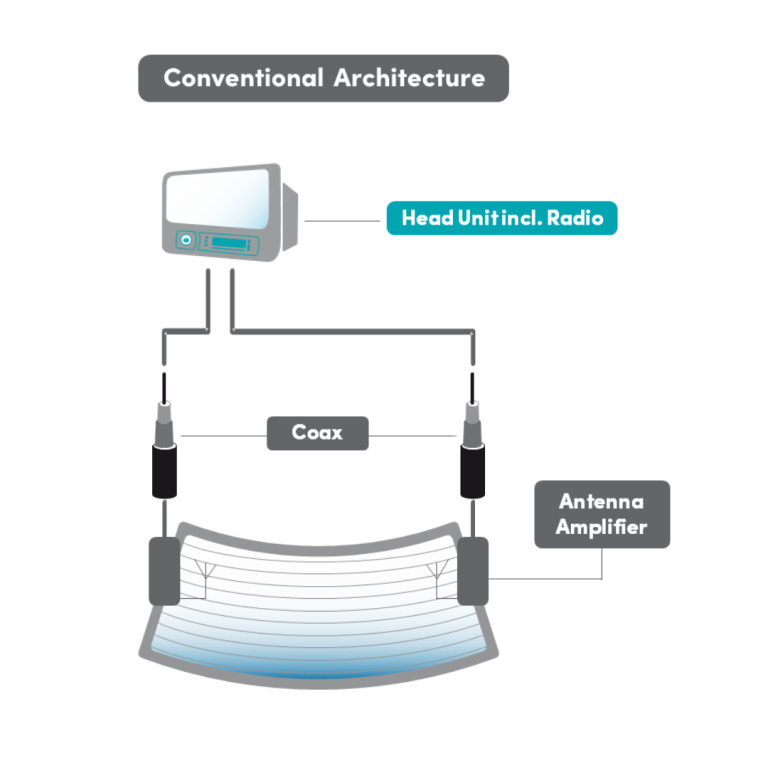
Key Challenges of Conventional Head-Unit–Centric Architectures
Thermal Density
Increasing radio and connectivity functions concentrated in the head unit create thermal stress in tightly packed environments, limiting performance and long-term reliability.
EMI / RF Interference
Proximity to high-power electronics increases electromagnetic interference, negatively impacting radio reception quality and overall system stability.
Antenna Complexity
Long coaxial cable runs, external antenna amplifiers, and additional connectors increase system complexity, weight, and integration effort.
Higher System Cost
Redundant components and complex wiring architectures inflate BOM, assembly, and validation costs.
Hirschmann Car Communication —
Remote Tuner Module (RTM)
Digitalization of Broadcast Radio Reception Enables a Simplified System Architecture
As conventional radio architectures reach their limits, modern vehicles require a new approach to radio integration. The Hirschmann Car Communication Remote Tuner Module (RTM) addresses the limitations of conventional radio architectures by introducing a fundamental architectural shift. The RTM relocates radio reception from the head unit to a dedicated module positioned near the vehicle’s antenna system.
One Architectural Change. System-Wide Impact
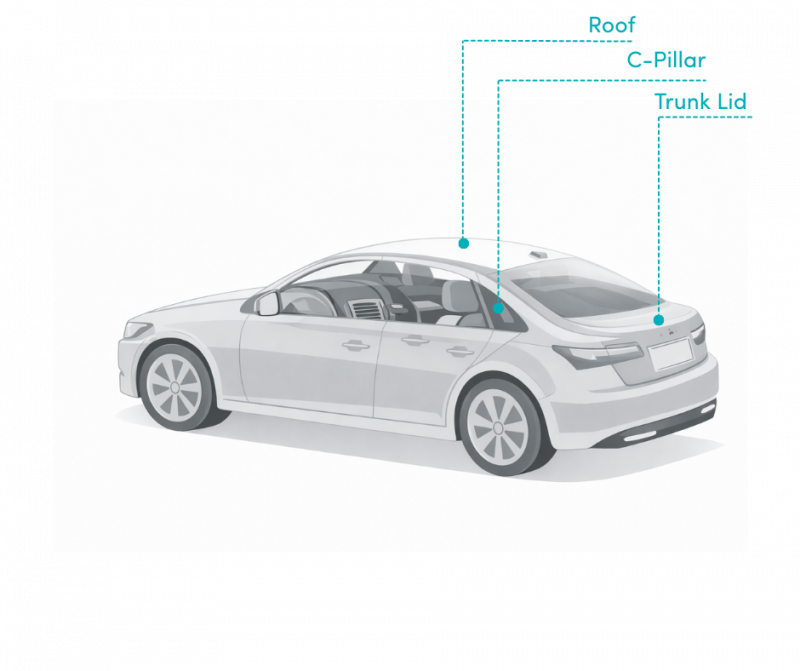
This distributed architectural approach allows the Remote Tuner Module (RTM) to be positioned at the roof, C‑pillar, or trunk lid, close to the antenna system where reception conditions are optimal. As a dedicated radio reception module, RTM receives broadcast signals (AM/FM/DAB/DAB+), processes them in an RF-optimized environment, converts them into digital audio, and transmits the signal to the head unit via a single digital interface.
By fully offloading radio reception from the head unit, RTM eliminates the need for antenna amplifiers, RF filters, shielding, and complex RF cabling within the infotainment domain. The head unit is simplified by design, allowing it to focus on processing, user interaction, and digital services.
With clean digital audio provided by RTM and simple control commands exchanged between systems, infotainment functions such as streaming, navigation, voice processing, and connectivity operate without RF interference. This enables greater design flexibility, improved system robustness, and consistent form factors across vehicle platforms.
Key Architectural Benefits
Lower System Cost
Eliminating antenna amplifiers, reducing coaxial cables and connectors, and simplifying assembly lowers overall system cost. A plug-and-play approach further reduces development and validation effort.
Optimized RF Performance
Locating radio reception close to the antenna ensures high signal quality and preserves integrity through digital transport, while decoupling performance from head-unit constraints.
Simplified Integration
Designed for easy replacement of conventional antenna amplifiers, the solution integrates with minimal system changes. A simplified API and digital audio interface reduce integration complexity and help shorten time to market.
50% reduction in wiring
complexity
Single-module
integration
OEM-certified
architecture
Reduced
time-to-market
Conventional vs. Remote Tuner Architecture
System Level Comparison
| Conventional Architecture | RTM Architecture | Business Impact of RTM | |
|---|---|---|---|
| Tuner Location | Integrated in head unit | Trunk lid / C‑pillar / Roof (near antennas) | Optimized RF performance and improved signal quality |
| Antenna Amplifiers | Multiple antenna amplifiers required | Antenna amplifiers eliminated | Fewer components, lower BOM cost |
| Coaxial Cable | Coaxial cable runs from each antenna to head unit | Single digital interface (A2B / Ethernet) | Lower material usage, cost reduction, weight savings |
| Heat Management | Critical challenge in head unit | Eliminated by external placement | Lower thermal stress, increased reliability |
| EMI Exposure | High EMI risk in dense head unit | Reduced EMI due to remote placement | Cleaner RF environment, more stable performance |
| Head Unit Variants (Global) | 8–12 SKUs | 2–3 SKUs | 75–85% reduction in head unit part numbers |
| Integration Time | Months of development | Plug-and-play, simplified API, pre-validated module | Minimal adaptation effort, faster time-to-market |
| RF Performance | Limited by distance from antenna | Optimized through proximity to antenna | Stronger reception, fewer customer complaints |
Built for Demanding Automotive Environments
Designed to perform reliably across complex vehicle architectures.
Power Supply
9.0 – 18.0 V DC
with reverse polarity protection
Operating Temperature
–40 °C to +85 °C
Reception Standards
AM / FM / DAB / HD Radio
Primary Interface
A2B (Ethernet optional)
Antenna Connections
Dual FAKRA connectors
Optional MQS 3‑pos + Single FAKRA
Seamless Linking
FM–FM, FM–DAB, DAB–DAB, FM–HD
Global Product Variants
Configured for Regional Standards and Global Vehicle Platforms
Europe
- Part Number: 920–787-101
- Reception Standards: AM, FM, DAB
- Features: Phase-Diversity, DAB MRC, Seamless Linking, Data Tuner (TMC, TPEG)
USA
- Part Number: 920–787-131
- Reception Standards: AM, FM, HD Radio
- Features: Phase-Diversity, HD MRC, Data Tuner (SDARS support on request)
Global
- Part Number: 920–787-161
- Reception Standards: AM, FM
- Features: Phase-Diversity, Data Tuner
Trusted by Global Automotive Leaders Engineered for Your Success
Automotive-Grade Quality
With deep automotive RF expertise, Hirschmann Car Communication delivers standards-driven connectivity solutions—designed, tested, and certified to meet the highest automotive requirements, trusted by global OEMs, and proven in thousands of vehicles on the road.
Proven Track Record
Hirschmann Car Communication manages the full development lifecycle from concept to production validation with advanced RF testing, global homologation expertise (EU, North America, China), and ISO 9001-certified manufacturing to ensure consistent quality at scale.
Technical Support
Dedicated engineering team ready to support integration, customization, and deployment for your specific platform.
Scalable Integration Options
Standardized or customized designs to match OEM architecture and program requirements
Off-the-Shelf RTM
A ready-to-integrate Remote Tuner Module designed for fast deployment in series production programs
✓ Immediate Availability
Deploy within weeks, not months
✓ Proven Configurations
Tested designs for automotive platforms
✓ Lower Development Cost
Minimal engineering, faster ROI
✓ Standard Support
Documentation, API, and technical assistance
Customized RTM Solution
A tailored Remote Tuner solution optimized for your specific vehicle architecture and program requirements.
✓ Tailored Design
Built for your specific OEM requirements
✓ Custom Interfaces
A2B, Ethernet, or proprietary protocols
✓ Integration Support
Expert engineering team guides implementation
✓ Long-term Partnership
Ongoing support, firmware updates, evolution
✓ Custom Chipset
Expert engineering team guides implementation
✓ Radio Type Approvals
Certification of additional countries upon request